Tuesday, January 4, 2011

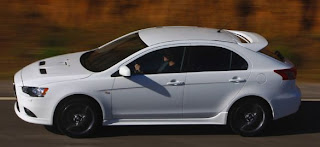
The 2011 Lancer Evolution --Even Badder!!


The Ultimate 4-Door Sports Car - Adds New High-Tech Luxury Amenities At No Additional Cost To The Consumer

With its rally racing-inspired design, electronic driver aids and potent turbocharged power, the Mitsubishi Lancer Evolution is one of the most capable high-performance sports sedans in the marketplace today. But the lusty appeal of this instantly recognizable 4-door is not limited just to the North American market; the "Evo" has a rabid fan following throughout the world. Two versions of the Lancer Evolution will be offered in the U.S. market for the 2011 model year: the GSR model that features a short-throw 5-speed manual transmission along with a long list of stard features as well as numerous advanced electronic driver aids including the advanced Super All-Wheel Control (S-AWC) full-time all-wheel drive system and an even better equipped MR edition that includes Mitsubishi's remarkable 6-speed Twin Clutch Sportronic-Shift Transmission (TC-SST).

New for 2011

Mitsubishi's FUSE Hands-free Link System™ This innovative technology gives users the ability to access their Bluetooth-enabled cell phone, iPod or USB drive with the sound of their voice. By using simple voice commands, users can make hands-free phone calls and play their favorite songs by artist, genre, album or playlist. What's more, the Gracenote® software that recognizes the names of musical artists and their songs can be updated for free so that as consumers add more and more new music, the FUSE system will recognize these new voice commands.

Real-Time Traffic (RTT) A very convenient and informative real-time traffic (RTT) function has been added to the available 40GB HDD navigation system.

Retuned Exhaust -The Lancer Evolution's exhaust system has been tuned for an even more sporty-sounding exhaust note. Sporty-looking Rear Spoilers All Lancer Evolution GSR models now include a large rear spoiler at no additional cost to the consumer, with the MR version receiving a stylish low-key rear lip spoiler. USB auxiliary input Every Lancer Evolution features a convenient USB port that is easily accessed inside the storage bin between the two front seats.

Aggressive Racing Car-Inspired Styling Automotive enthusiasts - especially fans of motorsports - have long appreciated the distinctive and aggressive body lines that have been a trademark characteristic throughout the years for the Lancer Evolution sports sedan. The current 10th-generation car continues to carry this trend but does so with a design aesthetic that is arguably the most refined interpretation of this legendary high-performance sports sedan's long and storied sporting history. Inspired by the air intakes on jet fighters, the tall and wide openings of the car's front fascia not only lend the Lancer Evolution an imposing face but also flow vast volumes of air into the engine compartment to provide beneficial cooling to the radiator and intercooler, helping to maximize power production. Vents located atop the lightweight aluminum hood and on the sheetmetal aft of the front wheels are as functional as they are stylish as they help to evacuate hot air from within the engine compartment.

Protruding fenders at all four corners, a relatively tall beltline that slopes slightly downward towards the front of the vehicle and the car's short rear deck lid all combine to give the Lancer Evolution a stance that is both muscular and attractive-looking. A tall trunk lid-mounted rear spoiler (GSR model) or a low-profile rear lip spoiler (MR model) round out the 2011 Mitsubishi Lancer Evolution's exciting race car-inspired exterior styling.

Exhilarating Turbocharged/Intercooled 2.0-Liter Engine The well-engineered 4B11 T/C engine is at the heart of every Lancer Evolution's fast-paced athleticism - it can get the pulse racing of even the most jaded automotive enthusiast with its ultra-quick acceleration and loads of instantaneous power on tap at seemingly any point of the tachometer's rev range. Though only 2.0-liters (1,997 cc) in displacement, this hearty DOHC 16-valve inline-4 powerplant consists of an all-aluminum engine block and cylinder head (for high-strength and light weight) and a bore and stroke that both measure exactly 86.0 mm (3.4 in.), making it a "square" design as its bore-stroke ratio is 1.0. Power ratings for this engine are 291 horsepower at 6,500 rpm with a full 300 lb.-ft. of torque produced at a much lower 4,000 rpm. Mitsubishi Innovative Valve timing Electronic Control system (MIVEC) works on both the intake and exhaust camshafts for optimized power production and cleaner exhaust emissions. This turbocharged/intercooled engine's compression ratio is 9.0:1.

Short-Throw 5-speed Manual or Rapid-Fire 6-speed Twin Clutch Sportronic-Shift Transmission As standard equipment on the 2011 Mitsubishi Lancer Evolution GSR, the 5-speed manual gearbox is a driver's delight. Its shift lever navigates through the gates with rifle bolt-like precision with each short, satisfying throw. The driver will also find that the lightweight clutch pedal operates in a similar manner. The functionality of both the shifter and the clutch pedal reward the operator with a high degree of mechanical feel - precisely what one wants from a high-performance sports car. But while the smooth operation and tactile feel of the manual transmission found in the GSR model offers satisfying performance, the hard-core driving enthusiast will surely opt for the high-tech transmission included in every Lancer Evolution MR model.

Mitsubishi's revolutionary Twin Clutch Sportronic Shift Transmission (TC-SST) is nothing short of an engineering marvel. The TC-SST allows the driver to perform shifts in a fraction of the time that they could be performed with a standard manual transmission. The system also allows the driver to make these shifts via the console-mounted shift lever or even more conveniently by magnesium steering wheel paddle shifters. What's more, this close-ratio 6-speed Twin-Clutch Sportronic Shift Transmission can operate in a fully automated mode, just like the typical automatic transmission. In either manual or automatic mode, each up or down shift takes place instantaneously with no perceptible lag time, with the engine management system "blipping" the throttle with every downshift, matching the engine and transmission speeds perfectly.

Supercar Performance from Super All-Wheel Control (S-AWC) Mitsubishi's Lancer Evolution has always been known for its exceptional handling prowess. But the advanced electronic driver aids on the current generation vehicle - especially the company's superb Super All-Wheel Control (S-AWC) system - have taken the Evolution's road hugging maneuverability to an astonishingly high level. Super All-Wheel Control (S-AWC) is not one specific device but a network of technologically-advanced dynamic systems that constantly communicate with each other to provide optimized tractability. These include Active Stability Control (ASC), an Active Center Differential (ACD), an Active Yaw Control (AYC) rear differential, and Sport ABS brakes. Working in concert, Super All-Wheel Control (S-AWC) modulates torque delivery to each wheel in real-time for maximum control. The Active Stability Control (ASC) includes the vehicle's traction control and stability control systems and helps to regulate brake force and engine power distribution at each individual wheel. The Active Center Differential (ACD) uses an electronically-controlled hydraulic multi-plate clutch to split engine torque (up to 50:50) between the front and rear wheels. This routing of engine power between the front and rear of the vehicle is determined by data collected from a variety of sensors including individual wheel speeds, throttle opening, steering wheel angle, and the vehicle's lateral and longitudinal positioning. Acting in a similar fashion to a conventional limited-slip differential, the Active Yaw Control (AYC) rear differential utilizes a planetary gear differential, yaw rate sensor and brake force control via the Active Stability Control (ASC) system to control rear wheel torque for improved traction and stability in slippery road conditions and high-speed cornering. And thanks to advanced brake pressure and yaw rate sensors, the Sport Anti-lock Braking System (ABS) helps the driver to maintain better steering control on slippery surfaces or under very heavy braking.

Advanced Sport-Tuned Chassis and Suspension A highly rigid structure, strong but lightweight components and a superbly-tuned independent suspension system make up the foundation of every Lancer Evolution. The Evo's platform features ample use of ultra-strong yet lightweight high-tensile steel along with a hood, greenhouse and front fenders composed entirely of lightweight aluminum. Mitsubishi engineers cleverly placed the car's battery and windshield washer fluid reservoir in the trunk to help improve overall vehicle weight distribution. The suspension consists of a McPherson type strut (inverted strut) design at the front of the vehicle with a multi-link suspension employed at the rear. To improve unsprung weight, the control arms for both the front and rear suspensions are constructed of forged aluminum. Another Lancer Evolution strong suit is its incredible braking ability, thanks to a Brembo braking system that uses 4-channel Sport ABS with Electronic Brake-force Distribution (EBD) and large ventilated rotors at all four corners (13.8-in. diameter with 4-piston calipers up front and 13.0-in. diameter with 2-piston calipers in back). The Lancer Evolution MR model's brakes are even more advanced as they employ a two-piece rotor design for reduced weight. Super-sticky 245/40R18 Yokohama ADVAN asymmetrical performance tires wrapped around 18 x 8.5-in. wheels (Enkei® cast-alloy on the GSR and BBS® forged-alloy on the MR) round out the ultra-high-performance componentry and design that make this sensational performance car every bit as capable on the racetrack as it is comfortable for driving in the real world.

World-Class Daily Driver Having made its mark on the world in motorsports competition including multiple championships in the grueling World Rally Championship (WRC) where combatants battle it out on courses that include sand, gravel and paved roads, the current Lancer Evolution is a delightful vehicle to live with on a daily basis thanks to its excellent ergonomics and thoughtful amenities. Supportive yet comfortable RECARO® front bucket sports seats work well for either quick trips or long daily commutes, while a sumptuous-sounding 6-speaker 140-watt AM/FM/CD/MP3 audio system with digital signal processor, cruise control, automatic climate control, remote keyless entry and power windows, side mirrors and door locks help make extended time behind the wheel very pleasurable. A Touring package is also available for the MR that consists of a power glass sunroof; leather seating surfaces for the RECARO® seats; improved sound insulation; rain-sensing wipers; automatic on/off headlamps and heated front seats and door mirrors.

Advanced Safety Technologies The 2011 Mitsubishi Lancer Evolution features numerous innovative safety technologies to help protect all of the vehicle's occupants. Every Evolution is endowed with Mitsubishi's next-generation Reinforced Impact Safety Evolution (RISE) unibody platform that, in the event of side or rear collisions, helps to dissipate energy away from the vehicle's occupants to improve protection from injury; the RISE system also helps to protect the fuel system from rear impacts. Seven air bags are also included: Advanced dual front air bag supplemental restraint system (SRS) with occupant sensors, front seat-mounted side-impact air bags, side curtain air bags and a driver's side knee air bag. A Tire Pressure Monitoring System (TPMS) and anti-lock braking system (advanced Sport ABS included on the Lancer Evolution) with Electronic Brake-force Distribution (EBD) are also included

Monday, November 15, 2010

2011 Mitsubishi Outlander SPORT is In-Stock


In November 2010, the 2011 Mitsubishi Outlander Sport debuted to the US and shortly after we received our first Outlander Sport at Jim Butler Mitsubishi of South County in St. Louis.

The greatest thing about this CUV is that it has the capability of an Outlander GT but in a smaller-sportier package, and it is even more agile on the road. We like to think of the Outlander Sport as the CUV version of the Lancer GTS sedan. So for those of you that don't know anything about the Lancer GTS, we'll elaborate.

The 2011 Mitsubishi Outlander Sport has a sport-tuned suspension, magnesium paddle-shifters, CVT transmission that acts fast & shifts smoothly, 18" Aluminum-Alloy wheels, and a 2.0ltr 31mpg/hwy gettin' 4 cyl with 148hp. Check out our great selection!

www.JimButlerCars.com


Friday, November 12, 2010

Mitsubishi's New Super All Wheel Control System on the Outlander GT

The new Super All Wheel Control system, what sets it apart?

The new 2010 Mitsubishi Outlander GT comes equipped with the new Super All Wheel Control (S-AWC) system. What sets the "Super" All Wheel Control system apart from the original All Wheel Control (AWC) system found on plenty of other models.

Lets first talk about the original AWC system so we can differentiate between the two types. All Wheel Control is designed to ensure that your car grips the road with the most amount of torque possible at all times. Depending on the feel of the road, as well as your input on the accelerator and brakes, the AWC system will shift torque between the front and rear wheels to maximize control over the motion of the vehicle.

The S-AWC system takes things to a whole new level. Instead of shifting torque between the front and rear wheels, the system can actually shift power laterally, as in side-to-side. This greatly increases the vehicle's balance and control over the AWC system, particularly when you are cornering or navigating turns at high speeds or on slick surfaces.

Visit our Inventory

Saturday, October 9, 2010

Review of the 2010 Lancer Sportback at Jim Butler Mitsubishi

The Mitsubishi Lancer Sportback is based on the Lancer sedan and with that has the only two of the 4 available trim levels as the Lancer sedan. The Sportback comes in either a GTS or Ralliart trim level, which transforms into cool and coolest!

The GTS is powered by Lancer's energetic 168-hp I-4, but the Ralliart trim trades up to a 2.0-liter, 237-hp turbo four that makes 253 lb.-ft. of torque. That go-go that the Lancer Sportback Ralliart puts to all four wheels via Mitsubishi's automatic transmission with the Twin-Clutch Sportronic Shift Transmission feature is nothing short of awesome.

The Twin-Clutch Sportronic functions as a typical automatic, but it also can be shifted manually via the console shifter or wheel-mounted paddles. The two clutches — one for odd gears, one for even — allows for seamless thrust as the Mitsu snaps through the gears because one clutch or the other is always ready to engage the next gear.

The real thrill is the Sport Mode on the transmission. When engaged it raises the the RPM shift points for a sportier, and more thrilling driving experience.

The Ralliart's sharp steering, rally-car handling, confident braking and a sporty ride are accomplished by its fully independent, sport-tuned suspension and speed-rated tires, making it a great addition to the Lancer and Mitsubishi models.

The optional Recaro seats, straight-forward gauge display and floor shifter — a corkball-like shift knob that looks and feels as if it were connected to a manual transmission — are very cool.

The Styling is a straight carry-over from the Lancer sedan with its shark-face grille, hood nostrils, raptor-eye headlights and 18-inch sport alloy wheels. Now it has a hatchback handiness and 57 cubic feet of seats-folded cargo space make it a more versatile vehicle that can be used for more than just hauling around 5 passengers.

View our inventory of the 2010 Lancer Sportback here!

2010 Remote Control Test Drive-Register NOW!


The All-New 2011 Mitsubishi Motors Outlander Sport is Set to Become the 'World's First Online Test Drive'


CYPRESS, Calif., Oct. 7-- Starting November 1st and continuing through November 10th, 2010, Mitsubishi Motors North America, Inc., (MMNA), will host Mitsubishi Live Drive, the World's First Online Test Drive of an actual vehicle utilizing interactive remote control of the company's latest automotive creation, the all-new 2011 Outlander Sport.

Residents of the United States who are 18 years and older with a valid driver's license will be able to register to have the chance to take a virtual jump behind the wheel to drive the all-new, affordably-priced 2011 Mitsubishi Outlander Sport, a handsome and sure-footed 5-passenger compact crossover vehicle (CUV) with numerous available high-tech features normally associated with expensive high-end vehicles that starts at only $18,495. Available amenities include a panoramic sunroof with LED accent lighting; a 710-watt Rockford-Fosgate® sound system with 10-in. subwoofer; a 40GB HDD DVD-based navigation system with a large, 7-in. touch-screen, real-time traffic and storage for up to 3,000 songs; a quick-shifting continuously-variable transmission (CVT) with magnesium-alloy steering column mounted paddle shifters; One-touch Start/Stop (OSS) engine switch; and an electronically-controlled All-Wheel Control (AWC) system, to name but a few.

Using a combination of remote control software and hardware and a unique system interface, participants will be able to take an actual 2011 Outlander Sport for a virtual spin on a closed course from their personal computers. "We have worked hard to devise a truly innovative marketing campaign utilizing cutting edge technologies to recreate a genuine Mitsubishi-experience that engages consumers upfront about the new 2011 Outlander Sport and the Mitsubishi Motors brand," said Gregory Adams, Vice President of Marketing MMNA. Working with our creative advertising agency 180 LA, our digital agency-of-record, Schematic, a WPP company, and partners B-Reel, a leading production company that specializes in superlative media for television, digital signage and internet campaigns, and world-renowned experts Dr. James Brighton (robotics) and Simon Cave (web design), this team has combined multiple point of view (POV) video cameras onboard the Outlander Sport, advanced electronic receivers and state-of-the-art servo motors to control the vehicle's dynamics and sync it with precision GPS mapping to allow participants the remarkable opportunity to drive Mitsubishi's hot new crossover via interactive remote control.

"We see this project as part of the ever-expanding blur between the virtual world and the physical world," noted William Gelner, Executive Creative Director at 180 LA. "A prime example of how technology continues to evolve the way we approach even the simplest experiences, like test-driving a car."

The online test drive is part of an integrated marketing effort that kicks off October 15th through January and includes television, print, digital and direct mail.

Participants will enjoy the feeling of literally being in the driver's seat. This experience gives the driver almost total control over the Outlander Sport. Drivers will be able to experience many of the Outlander Sport's deluxe features while performing the test drive, plus enjoy the challenge of collecting vehicle "feature pods" while learning about this crossover's cool tech features and amenities.

Those wanting to participate in the World's First Online Test Drive can start signing up on October 15 at the car's microsite, www.outlandersport.com, to obtain a code that can be used to queue for the live test drive on opening day, November 1st.

[SOURCE Mitsubishi Motors North America]

Friday, September 24, 2010

All-New 2011 Mitsubishi Outlander Sport at Jim Butler South County

In 2010, Mitsubishi came out with the All-New 2010 Mitsubishi Outlander. Ever since it hit the streets we've had nothing but great response from our customers. Now Mitsubishi has made a slightly more energetic version, the 2011 Mitsubishi Outlander Sport!

From all outward appearances, Mitsubishi could be considered the Chrysler of Japan. Its products have grown fragmented. Its focus scattershot. Its past interiors... well, the less said the better. So it was a breath of fresh air to hear that Mitsubishi's attention will be centered on two core marques going forward: the Lancer and Outlander.

With the Galant toiling away in obscurity and the Eclipse a heavyweight shell of its former self, the Japanese automaker's compact sedan and crossover lines are the two remaining bright spots in its portfolio (all-electric iMiEV aside).
And if you're looking for a Lancer, Mitsubishi has you covered. In spades. A basic runabout? Easy. A tech-laden, turbocharged, all-wheel drive sports sedan. Done. Name your price and priorities, and there's a Lancer for you.

But what about the Outlander?
Enter the Outlander Sport, a right-sized CUV that takes the core components of its bigger brother and distills them into a smaller, lighter package.
View the Outlander Sport alone and it's tough to tell that it shares its entire architecture with its larger namesake. But side-by-side, the similarities are obvious. The wheelbase remains unchanged at 105.1 inches, but the Sport's overall length has been cut down from 183.7 to 169.1 inches. While there's a redesigned rear floor pan, new front deck and crossmember, nearly everything underneath has carried over from the standard Outlander, including its front MacPherson struts and multi-link rear suspension, which have been slightly tweaked with different spring rates and a smaller diameter rear sway bar.

The styling is just as aggressive as its larger sibling, complete with Mitsubishi's "jet-fighter grille" and square hatch. The Outlander's slab sides have been augmented with subtle upswept swage line that runs aft of the front wheels and terminates above the rear fender flares. With the wheels (16-inchers standard, 18-inch hoops on the SE) pushed to the outer edges of the Sport-specific body work and a class-leading 0.32 cD, the smaller Outlander comes across as more athletic than its brethren. And with the wheelbase intact, a minimal reduction in both width (less than an inch) and height (almost two inches) pays dividends inside.

Front and rear headroom is nearly unchanged because the A- and B-pillars, along with the seat structures, are direct port-overs from the larger Outlander. However, everything else – save the steering wheel – is new to the Sport.

It's a different take on the same Mitsubishi theme – a darkened cabin accented by fauxluminum and a smattering of chrome – but the materials and textures are notably better than some of the pieces found in the Lancer line. The tilt and telescoping leather steering wheel is pleasing to the touch, the switchgear and stalks above average, while the climate controls are blissfully simple in both design and execution. The dual gauges are bisected by a multi-information display, all of which remains clear and readable no matter the lighting. The standard stereo is an ode to simplicity, while the optional sat-nav/rear-view camera and 710-watt, nine-speaker Rockford-Fosgate stereo brings the noise and does its part to upgrade the dash.

The standard kit – power door locks, side mirrors, windows, redundant steering wheel controls and remote keyless entry – are par for the course nowadays, while the FUSE hands-free system is something we're pleased to see as part of the base package. It's a similar take on Ford's SYNC system, melding Bluetooth wireless audio and phone support with voice controls and a USB jack for MP3 players. We'll have to wait for a full test to get completely accustomed to the system, but a couple of quick trials returned reasonable results.

A few tugs on the six-way, manually-adjustable driver's seat gets us comfortable quickly, although the general lack of bolstering and the cushion materials have us questioning how good we'll feel during prolonged runs. And we'd be remiss not to point out the odd placement of the heated front seats on our ES tester (HID headlamps, FAST key system, push-button start) on a separate panel below the cushion and ahead of the seatbelt housing. Like we said, odd.

While Mitsubishi did its best to deliver a competent interior, the Sport is still a budget-oriented model, so some of the major touch points are better than others. In other words, it's still a power-lifter affair – impressive up top and underwhelming down below. The one exception is the Premium Pack's panoramic glass roof with adjustable LED "mood lighting." We didn't get a chance to play with the discotastic LEDs in the dark, but the glass roof is a sweet option in the segment, even if its framed by a less-than-pleasing (okay, mouse fur) headliner.

When our man Lieberman flogged the Outlander GT in Palm Springs late last year, he came away impressed with the large CUV's overall handling and tarmac-gripping abilities. The combination of a V6 powerplant and Mitsubishi's superlative Super All-Wheel Control made it a surprisingly entertaining steer. Some of those genes have carried over to the Sport, but kept the sticker competitive – "well under" $19,000 for the ES with a five-speed manual, below $22k for the SE/CVT combo and less than $25,000 for the full nav-equipped package.

The same MiVEC-equipped 2.0-liter four-cylinder (4B11) found throughout the Lancer lineup is bolted into the Sport, churning out 148 horsepower at 6,000 RPM and 145 pound-feet of torque at 4,200 RPM. While that's not much for a crossover, bear in mind that the Sport loses around 400 pounds from the standard Outlander, and when equipped with the Sportronic CVT, Mitsu says the Sport should deliver an estimated 31 mpg on the highway.

While the value-priced ES model will only be available with front-wheel drive, the SE can be had with AWC, complete with a user-selectable terrain system that doles out power to either the front wheels or all four depending on the settings and conditions. Flick the switch into 4WD mode and control is given up to the eight different sensors and electric differentials, varying power with either more front wheel bias or a maximum split of 30:70 front-to-rear. Choose "Lock" and the split stays at 60:40 and provides the most natural blend of grip and balance.

Over a short test loop outside of Infineon Raceway in Sonoma, CA in a CVT-equipped SE model, the engine/tranny/AWC combo proved up to snuff for daily drudgery. Putting along between 25 and 65 mph, Mitsubishi's attention to keeping NVH levels in check shown through, with minimal wind and tire noise entering the cabin, bolstering its claim that the Sport is quieter on the inside than the larger Outlander.

On the flat and twisty with the AWC set to Lock, the Sport proved to be a competent handler, shuffling power to the proper wheels and with minimal body roll. The steering was predictably smooth, with a reassuring tightness mid-corner.

Mitsubishi also saw fit to equip the Sport with an "Eco" light on the dash to encourage lighter throttle inputs and a new Brake Energy Regeneration System which, partnered with a redesigned alternator, captures kinetic energy during deceleration to reduce electrical load. During our brief jaunt, the system operated unobtrusively, eschewing the "grabby" sensation of some other setups while providing reasonably progressive pedal travel. We didn't get a chance to flog the Sport too hard, but left-foot-brakers take note: when the accelerator and brake are applied simultaneously, Mitsubishi's brake override system will slow the Sport to a stop. Thanks, Toyota.

On that same front, Mitsubishi believes there should be no "options" when it comes to safety, so the Sport comes standard with seven airbags, stability control, ABS and Hill Start Assist – impressive, but also right in line with the best-in-class.

And that's a good way to sum up the Outlander Sport. For the price and the segment, it packs all the baubles you'd expect, plus something that sets Mitsubishi apart – its all-wheel drive system. With consumers in this segment less enamored with outright power and increasingly focused on how grunt reaches the ground, Mitsubishi has a chance to become one of the predominant players in the all-wheel drive set, a segment that Subaru has owned for decades and luxury automakers are finally beginning to recognize as a sales tool. Mitsubishi certainly has the necessary hardware, and it's fitted it to a well-priced, nicely equipped CUV.


[Source: Autoblog]

Friday, September 3, 2010

September Mitsubishi Owner loyalty! up to $1000 on select models


During the month of September, Mitsubishi is offering a special incentive for those loyal Mitsubishi enthusiast. Buy a 2010/2011 Lancer and Lancer Sportback, 2011 Galant, 2010 Endeavor and 2010 Outlander get a $1000 Loyalty Rebate this month.
*Some restrictions may apply and offer might not be combinable with other special offers.

check us out at www.JimButlerCars.com